

Learn how to make a straw box cooker so you can cook delicious meals without electricity. Discover the advantages of this self-reliant cooking method for power outages, outdoor activities, and to save money.
Follow this step-by-step guide to make a fireless cooker from items you probably already have on hand.
Updated February 2026
How to cook without electricity
One of the small appliances in my kitchen that I really rely on is my slow-cooker. It allows me to cook dinner without hovering over the stove all day.
But if the power goes out, my slow-cooker of course won't work. Electric stoves won't work either. Gas and propane stoves need electricity to ignite the cooking flame.
On our homestead, storms come through in the spring and fall that can knock out our electric power for hours, days, and even longer. In winter, ice storms can do the same.
But beyond power outages, there's another aspect that troubles me: leaving the house with the oven or slow-cooker running. Whether I'm out of the kitchen tending to chores in the pasture or making a quick trip to town, I don't leave appliances on.
However, there's a fascinating solution that harkens back to the resourcefulness of our ancestors, allowing us to enjoy a hot dinner whether we have electricity or not, whether we were in the house all day or working outside.
Here's how cooks of the past made a hot dinner and still got a hard day's work done: they used a straw box cooker, also known as a fireless cooker.
I first put our straw box cooker to the test during a winter power outage. You can read how it worked in Our Ice Storm Journal.
When storms roll in, cooking is only one part of the picture. Knowing where your emergency contacts are, having important phone numbers written down, and understanding how your household systems work matters just as much when the power goes out. Being prepared ahead of time reduces stress when routines are disrupted. Learn more about the SafeHarbor Emergency Binder System here.
What is a fireless cooker? - an introduction to safe indoor cooking without electricity
In its original form, a straw box cooker (or fireless cooker) was a wooden box that held a hot pot of food. Straw, hay, sawdust or other insulation was stuffed around the pot inside the box to hold in the heat..
The pot of food was first heated up on the stove or in the oven, then put into the "straw box" to finish cooking using the retained heat.
This post may contain affiliate links, which means if you click on a link and make a purchase I might earn a small commission, but it doesn't affect the price you pay. Read my disclosure here for more info.
Why you need a way to cook without electricity - the advantages of fireless cooking
Losing electricity isn't the only situation where you might want to use a straw box cooker, or fireless cooker as they are sometimes called.
It's an excellent reason to use one though. I'm sharing our personal experience with an ice storm that knocked out our power further down in this post.
But it's not the only reason. What if ...
- you need to work outside all day, perhaps baling hay, or putting up a fence, or working in the garden
- you're going on a road trip and would like to take dinner along so you can save money on a restaurant meal
- you want to take a hot meal to a new mother, or to a sick friend
- you're on a camping trip and want to spend the day hiking or fishing and then come back to camp where a hot meal awaits you
Modern adaptations of the straw box cooker - where can you buy a fireless cooker?
There are a few modern adaptations of the straw box cooker, if you'd prefer to buy something that fits your needs. But I'm going to show you how to make a straw box cooker with items you probably already have on hand below.
There are slow cookers, roasters and other cooking appliances with 12 volt power that are designed and marketed for truckers and travel. These items use the power of your vehicle to warm up and cook your food.
You can also buy thermal cookers such as this one. These consist of inner pots that nestle inside a thermos-type outer pot, and work similarly to the traditional straw box cooker, where you must warm up the food first, then transfer it into your homemade fireless cooker to continue cooking.
How to make a straw box cooker
You probably already have everything you need to make this simple straw box cooker:
- an ice chest/cooler
- a folded bath towel (or use a thick layer of newspaper such as the big Sunday edition)
- a blanket or two
- a heavy pot with lid that fits inside the cooler
An ice chest or cooler is a perfect container for your homemade fireless cooker. Its thick insulation helps trap the heat inside.
And you probably already have one in the garage.
What Size Cooler to Use
Start by choosing the heavy pot with a tight-fitting lid that you plan to use inside the cooler. A very tall stockpot may leave too much empty space above the food, so choose a pot that fits the amount of food you plan to cook.
Next, make sure the pot fits inside the cooler with room on all sides - including the top - for blankets and/or towels that will act as insulation.
Obviously, a lunch-sized ice chest will be too small. Choose a sturdy, hard-sided cooler rather than a soft-sided one.
For most home cooking, a medium to large cooler in the 28-48 quart range works best. These sizes allow enough room for insulation without leaving excessive empty space.
Very large ice chests (70+ quarts) can be harder to insulate efficiently unless you’re cooking for a crowd. You want enough space to surround the pot with insulation, but not so much space that you're trying to fill a large empty cavity with blankets.
Aim for a cooler that leaves about 3-4 inches of space around the pot on all sides and on top once it’s inside. That gives you plenty of room for insulation while still holding heat efficiently.
If you are cooking for two, you might need a smaller pot and a smaller cooler than someone who is cooking for a family or planning on making enough to share with neighbors.
 |
| An ice chest or cooler is a perfect container for a homemade straw box cooker. |
What to use inside the cooler
A folded bath towel on the bottom of the cooler insulates the bottom of the pot, holding the heat in. It also keeps the hot pot from melting the bottom of a plastic ice chest! Plan to use a 2-3" layer under the pot.
A really thick layer of newspaper (like a Sunday paper) works just as well as a towel - but those are getting harder and harder to find these days!
The blanket tucked around the pot helps hold in the heat (no straw needed in this modern version), and the tightly-closed lid of the cooler creates an insulated box that holds in the heat and cooks your food.
Add more towels or another blanket if you still have empty space in your cooler.
How to use a fireless cooker
The cooking process in a straw box cooker is very simple.
Test your pots and pans first to be sure one fits inside the cooler with enough space on all sides for insulation.
A heavy pot is best, and it must have a well-fitting lid.
To use the straw box cooker, bring your food to boiling on your stove or other source of heat.
Place the folded towel on the bottom of the ice chest, then lay the blanket on top in a single layer.
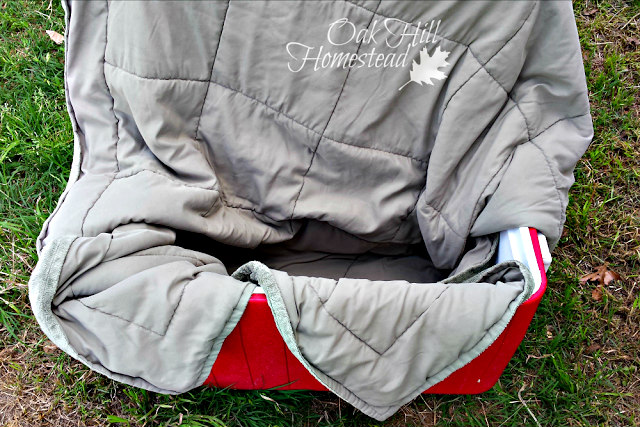 |
| Place the folded bath towel inside the cooler, and spread out the blanket. |
Set the hot pot of food on top of the folded bath towel and one layer of the blanket, inside the ice chest.
Wrap the rest of the blanket around the hot pot, and stuff the rest of the blanket around it to completely enclose the pot and fill the empty space in the cooler.
If there is empty space between the blanket and the cooler lid, add another blanket, more bath towels or even an old pillow. The goal is to stuff as much insulation inside the cooler as possible, and have no empty air space.
Then just shut the lid of the cooler tightly, and walk away.
By dinnertime your meal will be hot and ready to eat.
Heat your food to boiling first
Yes, you do need a source of heat to get started. (But you only need this heat source until the food reaches a full rolling boil, instead of burning propane or other fuel for hours while your meal cooks.)
Of course this isn't a problem if you have electricity and are using your straw box cooker to cook without power while you're away from home. However if you are in the middle of a power outage, you will need to heat your food to boiling in a different manner.
You can heat your food in one of many ways:
- Use a camping stove which uses small canisters of propane or butane as fuel. (We have this camping stove.)
- Heat your food on your BBQ grill's burner. This is the method we used recently after our neighborhood was hit by a tornado and we were without power for 5 days.
- If you're camping, you can heat your pot of food on a campfire while you're making breakfast. Your dinner will continue to cook all day in the fireless cooker.
Whichever method you choose to warm up your food, the fuel needed to heat your food will be minimal. Once you've moved your meal into the fireless cooker you won't need any added heat at all to continue cooking your meal.
Remember that this method of cooking is similar to using an electric slow-cooker. You'll need to allow several hours for your meal to cook in the straw box cooker.
 |
| Heat your food to boiling in the pot, then transfer it carefully and quickly into your homemade straw box cooker. |
Tips for using a straw box cooker
For best results, move your partially cooked food from stove top to straw box cooker quickly to conserve heat. Do not open the lid.
Have the blanket already lining the cooler and the folded towel placed in the bottom. Bring your food to a full rolling boil, then carefully move the pot of food, cover it all quickly with the blanket and shut the lid tightly.
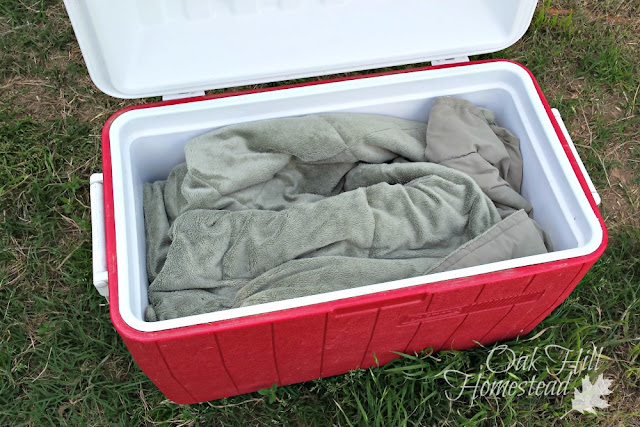 |
| After adding the pot of hot food to your straw box cooker, stuff the rest of the blanket over the pot and around the edges. Add another blanket or towel if there is extra space left on top. |
Allow enough cooking time to cook your food thoroughly by starting dinner early in the day. If it's something that you'd cook for eight hours in a slow-cooker, let it cook for at least eight hours in your straw box cooker too.
What to cook in a straw box cooker
Soups and stews are excellent fireless meals to prepare this way but don't overlook such dishes as baked beans or pot roast.
If it's a dish you can make in a slow cooker, you can make it in your fireless cooker too. Allow at least as much time as you would in a slow cooker.
Examples
What are some excellent fireless food items? You might like to know what we've cooked in our homemade straw box cooker.
When we had a dangerous ice storm in our forecast, I started lamb stew in the slow-cooker that morning, just in case.
We did lose power, but I simply moved the "crock" of hot food into my cooler-turned-straw-box-cooker and let it finish cooking.
On the second day of that ice storm power outage I opened a quart Mason jar of chicken and stock that I'd pressure-canned (a large can of chicken would work just as well), added a can of great northern beans, some dehydrated mushrooms and onions, and spices for white chili (aka chicken chili) such as cumin, chili powder, black pepper, and oregano.
After bringing it to a boil on our camp stove, I transferred the lidded pot to the straw box cooker, where it simmered away all day long. Dinner was delicious!
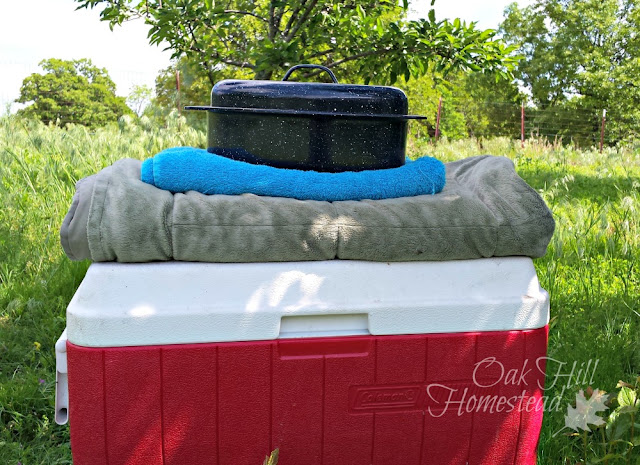 |
| You probably have all the materials needed to make a straw box cooker. |
What if the food isn't done?
If you open your straw box cooker and find the food isn't fully cooked, don't worry - simply return it to your heat source, bring it back to a full boil, and place it back in the cooker for additional time.
Of course, your fireless cooker won't hold the heat forever. Don't leave your cooked food in it overnight and expect it to be hot the next day. That would be inviting bacteria to develop.
Here are a few tips to ensure that your food will be piping hot and ready to eat:
- Bring food to a full rolling boil before placing the pot in your cooler/straw box cooker.
- Use a heavy pot with a tight-fitting lid
- Pack insulation tightly around the pot with no empty air space.
- Don't peek! Do not open the cooler's lid (or the inner pot's lid) while cooking.
- Allow at least as much cooking time as a slow cooker recipe.
- Choose your recipe wisely - see the section above "What to Cook."
 |
| Coolers and ice chests are pretty easy to find at yard sales. |
How to store your straw box cooker
When your meal is finished, leave the top of your ice chest open for a while to dry it out; it's steamy and damp inside. Air out your blanket and towel before storing them to prevent mildew.
You can return your blankets and towels to the linen closet, or you can store them inside the cooler for the next time they're needed.
The cooler can be stored in the garage or wherever you normally keep it. Keep the drain plug on the cooler closed to help keep bugs out during storage.
Preparedness Is More Than Food
Cooking without electricity is one piece of preparedness. Organizing your household information ahead of time is another. If you’re building a simple system to keep important details in one place, you can learn more about the SafeHarbor Emergency Binder System here.
A straw box cooker is a great use for an ice chest
Ice chests can often be purchased for $5 or so at yard sales, and you can use the pots and pans you already own. Make sure your pots and pans fit inside the cooler before you need to use your straw box cooker.
Using what you already have makes this a very inexpensive alternative to a slow-cooker - and you don't have to wait for a power outage to use it.
Putting a hot dish in this insulated chest is an excellent way to transport food to a potluck supper or to a picnic in the park with family or friends. Take it on a camping trip. It's a great solution for those who live off-grid too.
It's also a frugal way to save money on your power bill: just bring your dinner to a boil, then transfer into your prepared straw box cooker/ice chest to cook until dinner time while you work on another project.

Related Posts:
How to Prepare for Winter Storms
How We Prepare for Tornado Season

Facebook | Pinterest | Subscribe | Instagram

Kathi Rodgers is the gardener and writer behind Oak Hill Homestead (est. 2006) and the host of HOMEGROWN: Your Backyard Garden Podcast. With over 30 years of gardening experience in a variety of climates and soils, she helps new and aspiring gardeners grow healthy, organic food right in their own backyards.
A passionate advocate for simple, self-reliant living, Kathi is the author of multiple ebooks, a published magazine contributor, and shares practical advice with readers who want real-life solutions they can trust.
Kathi lives in Oklahoma, where she grows more cherry tomatoes than she can count and keeps a watchful eye on tornado season. A proud grandma and great-grandma, she believes that wisdom - like a bountiful garden harvest - should be shared.


