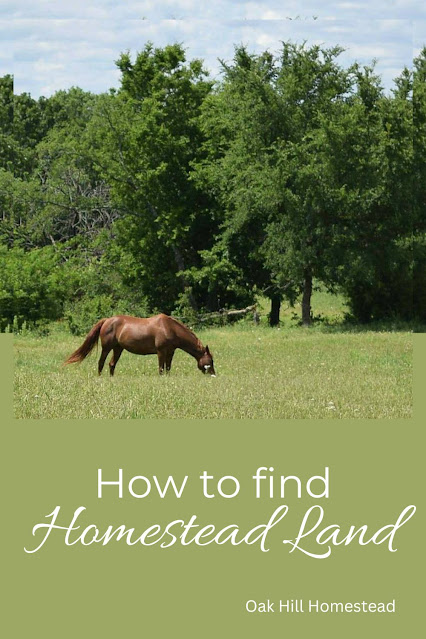
How do you find the perfect piece of land for your dream homestead? Here's how to identify exactly what you're looking for and how to find homestead land.
How to find and choose homestead land
When you're ready to buy land, how do you find the right piece of property? We looked for several years before finding Oak Hill, but it was worth the time it took.
This post may contain affiliate links, which means if you click on a link and make a purchase I might earn a small commission, but it doesn't affect the price you pay. Read my disclosure here for more info.
When we first started looking for our property, we had a short list of must-haves.
But as we looked, our list grew longer as we identified what we didn't like. In other words, we were able to identify what we did want by discovering what we didn't.
Many of those things hadn't even occurred to us before we actually looked at several properties.
Where to look for land for your new homestead
The first item on your list is probably the state or region where you want to live.
You may not want to leave the area where you are living now - or you might be willing to move out-of-state. You might want to move closer to family, or to a state with lower taxes or with better weather.
Whatever your reason, this will help determine how you search for your new homestead.
If you want to stay in the same general area where you now live, you'll be able to find local land for sale just by driving around or calling a local real estate agency. Family members might have some recommendations if you want to move near them.
But before you go searching for land, take some time to decide what's most important to you. Keep reading for more tips on finding the perfect homestead property.
Does the government still give away free land for homesteading?
In the Homestead Act of 1862, the US Government gave 160 acres free to whoever claimed it and met certain requirements.
While the Homestead Act is no longer in operation, there are a few states and towns that will give away land for free. Most of these are residential lots though, not large tracts of homesteading land. You can find more information here.

Make a wish list for your homestead land - what are you looking for?
Spend some time identifying the must-haves for you and your family. Divide your list into the things that you simply must have, and other things you can be more flexible about.
Start your "homestead land wishlist" with the most important items: the state or region in which you want to live, the minimum amount of land you want, and whether or not you want an existing house on the property or prefer raw land.
Click here to subscribe to The Acorn, Oak Hill Homestead's weekly-ish newsletter
and get my ebooklet "How to Make Vinegar from Scratch" for free!
If you want to raise livestock or chickens, write that down. Local ordinances and covenants can dictate whether animals are allowed or not.
For instance, twenty years ago we owned five acres of unimproved land in upper Michigan, which we planned to move to sometime in the future.
Imagine our surprise when we found out - after buying it - that we could not keep livestock on our land. We realized that raising animals was important to us, and we sold the land a short time later.
If gardening is important, you'll want a sunny location. A heavily-wooded lot probably wouldn't be ideal.
Make sure the land has access to water, whether it's a well, a year-round stream or spring, or other source.
And of course, set a price limit and don't go over it.
What was on our dream-homestead list
Our wish list contained things that were important to us, but might not be important to you. It looked something like this:
- At least ten acres
- Cheap land
- A low cost of living
- Low property taxes
- Relaxed building codes
- A warmer climate than Michigan - we were tired of snow!
- Good homeschooling laws
- Not on a dead-end road
- A good, reliable water source
We had a few other "wishes" on our list, but we were more flexible about those.
For instance, we wanted our land to have perimeter fencing, and cross-fencing (dividing the land into several pastures/fields) would be even better. Sheds or a barn would be nice, but we knew we could build them if needed.

Narrowing down the search for the perfect homestead land
Since we wanted a warmer climate, we knew we'd move south of our then-current location.
Because we wanted a state with homeschool-friendly laws, we further refined our search to the best states for homeschooling.
And finally, we wanted to be relatively close to a military base so we could continue to take advantage of the Chief's retirement benefits, so that narrowed our search even more.

Looking for land online
Finding land online is much easier now than it was when we began searching for our new homestead many years ago in 2003.
Internet searches are much easier to conduct and listings are much easier to find.
Here's a good place to start looking for homestead land. At Land Listings, you can filter the properties for sale with the features that are important to you.
For instance, you can sort the properties by state or even by county, the number of acres, whether or not there is a house on the property and so on.
Related posts:
How to Choose the Goat Breed that's Best for Your Homestead
Check out potential properties in person
Since we were willing (and even wanting) to move out of state, all the properties we were interested in were a distance away. When we found a property that fit our list of criteria, the Chief and our son traveled to look at it in person.
One of the properties they checked out had a junkyard next door.
Another, although it was indeed ten acres, was very narrow and very deep. We realized that we'd rather have land that was more square in shape. We wanted privacy from neighbors, and I didn't want to walk a long distance to the barn to care for animals multiple times a day.
Google maps makes this process much easier now, but years ago it wasn't very reliable or nearly as detailed.

Don't depend completely on those online maps though. That junkyard next door might have been a surprise if we hadn't gone to look at the property with our own eyes before purchasing it. Satellite maps aren't necessarily up-to-date.
I do not recommend buying property sight unseen! In fact, we bought Oak Hill from a woman who had done just that, and she put the property back on the market just three days after moving there.
Don't let that happen to you!
A dependable water source
Nothing is more important on a homestead than a reliable water source. Water is necessary not only for people, but also for garden plants, fruit-bearing trees, and livestock.
Check out that creek on your future property and make sure that it flows all year, not just during the rainy season.
If there is no natural water source, you'll need a well or to be hooked up to the city, county or rural water lines.
If you plan to collect rain water instead, is there enough rain during the year to provide for your storage needs?
Be sure to check state regulations regarding rainwater collection. While collecting rainwater is legal in all 50 U.S. states, some states have restrictions on how much you can store, how systems are installed, and even require permits to do so.
The states most commonly associated with restrictions are Colorado, Utah, Oregon Washington, Arkansas and Kansas, but don't assume that another state won't have restrictions too - and be sure to check local regulations as well.
On the other hand, some states actively encourage rainwater harvesting, such as Texas, Arizona, Virginia and Rhode Island. Some states even offer tax incentives or rebates.
How - and what - to research once you find a likely homestead site
Once you've found what looks like the perfect homestead land, be sure to ask questions.
Don't assume that your realtor will know the answers, but they might know who you should call. The local town or county will have the official answers for you, but it helps to know which department you should contact.
Here are a few questions to help you avoid surprises later:
- What is the state sales tax? Is there a local sales tax as well?
- Does this state have an income tax? Are there county or city income taxes?
- Does the state charge personal property tax on tractors and other equipment, RVs and other items?
- How much will the utility companies charge to hook up to a house you plan to build? And what utility companies service the land you are considering buying?
- What are the regulations about water rights?
- Is the road paved or dirt, and who is responsible for road maintenance?
- Do you need a permit to dig a garden? (Believe it or not, at our previous home the county required a permit to dig a garden any larger than 100 square feet. Yes, really. That's just ten feet by ten feet.)
- Do you need a minimum number of acres to have large livestock?
- What are the regulations on selling milk or eggs from your homestead?
- What are the state's homeschooling laws?
While these next two items weren't an issue when we moved to our homestead years ago, they are important today and might be to you too:
- Do you have a cell phone signal on your land? This can be very important in an emergency, such as when our neighbor had a heart attack, and when our barn burned down.
- Is internet service available? Satellite internet isn't the best, but it's all we can get on Oak Hill and it's better than nothing. UPDATE: Starlink has pretty much solved this issue, and recently they've removed the prohibitive upfront cost to set up their equipment.
Do your own due diligence
While you can find some of the answers to these and other questions online, others will need more research - and there might be additional issues you didn't even consider.
I suggest doing a deep and thorough search before you make your final decision and close the deal on a new property.
Parcel Scout can be your best friend in this situation.
They'll research records on a property you're considering buying. They'll pull county records, flood maps, zoning restrictions, easements and ownership history into one report at a very reasonable cost (less than $80 in most cases), which could save you a lot of heartache and money.
Make sure the property you're considering will fit your current needs and your future dreams too.
Finding the right land is worth the wait
Finding the right piece of homestead land isn’t something to rush.
The property you choose will shape your daily life, your routines, and what’s possible for years to come. Take the time to ask questions, walk the land, and think through both your needs and your long-term goals.
The perfect property might not check every single box, but when you find the one that fits your priorities, you’ll know it was worth the wait.
After several land-scouting trips, the Chief found Oak Hill. And the rest, as they say, is history. You can read more in my retrospective on a homesteading journey.